
Quick answer
CBSE school bus safety norms require affiliated schools to fit speed control devices limiting buses to 40 km/h, keep a qualified attendant on every bus, appoint a transport manager or coordinator, employ experienced, police-verified drivers, and carry a first aid box, an alarm and a mobile phone. Lapses in child safety can invite CBSE action up to disaffiliation, so check each rule against your records.
- CBSE's transport precautions (Circular 01/2012) are part of its Affiliation Bye-laws and, per NCPCR, are based on Supreme Court guidelines.
- Circular 19/2017 requires police verification and psychometric evaluation of all staff, including bus drivers and conductors.
- GPS tracking produces the trip, speed and route records that make compliance easy to demonstrate, and MoRTH's Rule 125H requires trackers in newer public service vehicles.
June 18, 20267 min readCompliance & Legal
1. The Regulatory Landscape in India
School transport regulation in India operates at three levels: CBSE circulars, Supreme Court/High Court directions, and state government rules under the Motor Vehicles Act. The result is a layered compliance requirement that many school administrators are only partially aware of.
The good news: compliance is achievable and, for the majority of requirements, technology-assisted compliance through GPS tracking is the most cost-effective path.
2. CBSE Transport Precautions for Affiliated Schools
CBSE added transport precautions to its Affiliation Bye-laws through Circular No. 01/2012, noting that safe transport had been raised by parents, transport departments and the Supreme Court, and that directions had been issued by the Board, the High Courts and the Supreme Court from time to time. Key requirements in that annexure include:
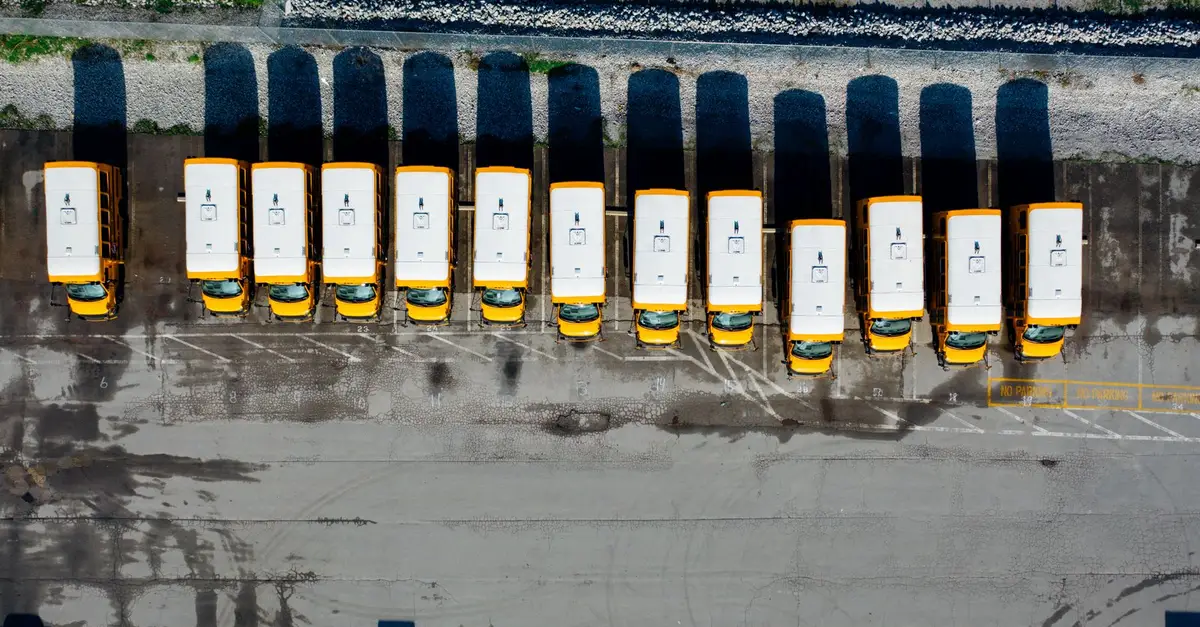
- Buses painted a uniform colour (preferably yellow) showing the school's name, "School Bus" (or "On School Duty" for hired buses) and a contact phone number
- Speed control devices so buses do not exceed 40 km/h, horizontal window grills with mesh, lockable doors and a fire extinguisher
- A qualified attendant on every bus and one designated Transport Manager/Coordinator per school
- Drivers with a valid licence and at least 5 years' experience of driving heavy vehicles; a driver challaned even once for over-speeding or dangerous driving cannot be employed
- An annual medical check-up of drivers, including eye tests, and refresher driver training at least twice a year
- A first aid box, an alarm bell or siren, and a mobile phone on each bus for emergencies
- Buses halting only at designated stops, with doors kept shut while moving
Circular No. 19/2017 added that police verification and psychometric evaluation must be done for all staff, with bus drivers and conductors checked "very carefully and in a detailed manner", and warned that safety lapses would invite action including disaffiliation. Circular No. 01/2022 reiterates that schools "must ensure the safety and security of the students in school bus and other school transportation" and directs them to follow the NCPCR's Manual on Safety and Security of Children in Schools, which repeats these bus rules.
3. Supreme Court Directions and Central Rules
CBSE's transport precautions trace back to court directions: the NCPCR manual states that CBSE's school transport circular is "based on the Supreme Court Guidelines". Separately, under Rule 125H of the Central Motor Vehicles Rules, MoRTH mandated a vehicle location tracking device and one or more emergency buttons in public service vehicles registered after 1 January 2019 (with exemptions such as two- and three-wheelers and vehicles that need no permit); for older vehicles, states and UTs notify their own compliance dates (MoRTH via PIB, 2019). Check with your transport department how this applies to the buses and vans your school uses.
Schools that experience transport accidents and cannot show any monitoring or safety management system are in a far weaker position to demonstrate that they took reasonable care.
4. State-Level Rules in Haryana
Haryana, like other states, sets its own rules for school vehicles on top of central requirements, so ask your district transport office for the current state policy. The Haryana Police has also conducted periodic checks on school vehicles — checking fitness certificates, driver licences, and overcrowding violations. Schools with GPS tracking are better positioned to demonstrate compliance during such checks because their route and occupancy records are digitally maintained.
5. Common Compliance Gaps
- No transport register: Many schools have verbal agreements with private van operators but no documented record of vehicle, driver, or route details
- No emergency protocol: No written procedure for what happens if a bus is late, involved in an accident, or a child is missing
- No speed management: School buses regularly exceed safe speeds with no monitoring in place
- Overcrowding: Capacity violations are common and go unrecorded
- No parent communication system: Parents have no reliable way to reach transport management in case of concern
6. How GPS Tracking Addresses Compliance Requirements
A GPS tracking system like SchoolTrack directly fulfils several compliance requirements:
- Digital transport register: Every trip is automatically logged with date, time, route, driver, and vehicle details
- Speed monitoring: Real-time speed alerts and historical speed logs demonstrate active speed management
- Emergency protocol: SOS button and automated alert system demonstrates a documented emergency response capability
- Parent communication: Automated arrival alerts and live tracking link demonstrates parent engagement
- Route documentation: GPS route replay provides documented evidence of route compliance
7. The Legal Liability of Non-Compliance
When a school bus accident results in child injury or death, the school's liability exposure is significantly affected by what safety systems were in place. A school that can demonstrate GPS monitoring, speed management, and documented emergency protocols is in a fundamentally different legal position than one that has no records at all.

The cost of GPS tracking is trivially small compared to the legal costs, compensation exposure, and reputational damage of a single serious transport incident. Compliance is not just about ethics; it is about risk management.
Sources
- CBSE — Circular No. 01/2012, transport precautions added to Affiliation Bye-laws (2012)
- CBSE — Circular No. 19/2017, Safety of Children in Schools (2017)
- CBSE — Circular No. 01/2022, Safety of Children in Schools (2022)
- NCPCR — Manual on Safety and Security of Children in Schools (2021)
- MoRTH — GPS Tracking System for Vehicles (Rule 125H, CMVR), Lok Sabha reply via PIB (2019)
Frequently Asked Questions
What do CBSE's school transport guidelines actually require of schools?
Has the Supreme Court weighed in on school transport safety directly?
What are the most common compliance gaps schools have today?
What's the legal risk for a school that isn't compliant?
DVM Techno Team
School Bus Tracking Software experts based in Jhajjar, Haryana. SchoolTrack — India's most affordable GPS tracking solution for schools. No hardware, no setup fee, 24-hour go-live.
Related Articles
SchoolTrack — India's Most Affordable School Bus GPS
No hardware cost. No setup fee. 24-hour go-live. The driver's phone becomes the GPS tracker.