
On this page
- What is the GST rate on gym equipment in India now?
- Which HSN codes and GST rates apply to gym equipment, accessories and supplements?
- What changed for gym equipment on 22 September 2025?
- What is the GST on dumbbells, treadmills, gloves, mats and bags?
- How do you calculate GST on gym equipment?
- Can a gym claim input tax credit on equipment?
- What should gyms and equipment sellers check on every invoice?
- How DVM Techno Can Help
- FAQs
Key takeaways
- Articles and equipment for general physical exercise, such as treadmills, exercise cycles and dumbbells, sit in the 18% schedule from 22 September 2025.
- Sports goods other than exercise equipment, and leather gloves specially designed for sports, moved from 12% to 5%.
- Supplements take the rate of their own HSN heading, so read the HSN on the supplier’s invoice and confirm it with your CA.
- A gym charging 5% on membership cannot take input tax credit on equipment it uses for that service, so GST on equipment becomes part of its cost.
What is the GST rate on gym equipment in India now?
From 22 September 2025, articles and equipment for general physical exercise, gymnastics and athletics, which covers typical gym machines and free weights, are taxed at 18% GST. Sports goods other than exercise equipment are taxed at 5%. A gym that charges 5% on membership cannot claim input tax credit on the equipment it uses for that service.
The rates come from the goods rate notification that put the GST Council’s September 2025 rate rationalisation into effect. This guide covers what a gym, studio or equipment shop buys or sells as goods. For the tax on the fees members pay, read our guide to GST on gym membership.
This guide is general information, not tax advice. Classification and credit depend on your facts, so confirm the HSN and rate for each product with your CA.
Which HSN codes and GST rates apply to gym equipment, accessories and supplements?
The rate depends on the HSN heading the product falls under, not on the fact that a gym uses it. The table lists only entries we checked in Notification No. 9/2025-Integrated Tax (Rate), dated 17 September 2025 and in force from 22 September 2025, and in the GST Council’s PIB press release of 3 September 2025.
| Description in the notification | HSN | GST from 22 Sep 2025 | Source |
|---|---|---|---|
| Articles and equipment for general physical exercise, gymnastics, athletics [other than sports goods] | 9506 | 18% | Schedule II, entry 619 |
| Sports goods other than articles and equipment for general physical exercise | 9506 | 5% (was 12%) | Schedule I, entry 499; PIB list: sports goods and toys, 12% to 5% |
| Gloves specially designed for use in sports | 4203 | 5% (was 12%) | Schedule I, entry 291; same PIB list |
| Travelling bags, rucksacks, sports bags and similar containers | 4202 | 18% | Schedule II, entry 145 |
| Food preparations not elsewhere specified or included [other than pan masala] | 2106 | 5% (was 18%) | Schedule I, entry 145; PIB food sector list, 18% to 5% |
| Albumins, including whey protein concentrates with more than 80% whey proteins | 3502 | 18% | Schedule II, entry 73 |
The IGST rate applies to supplies between states. Within a state, the same total is split equally into CGST and SGST, so 18% is charged as 9% CGST plus 9% SGST.
What changed for gym equipment on 22 September 2025?
Gym exercise equipment did not get a rate cut; sports goods did. The PIB release lists "sports goods other than articles and equipment for general physical exercise" and sports gloves under a 12% to 5% change. Exercise equipment is not on that list and appears in the 18% schedule of the new notification.
That wording matters for shops that sell both. A cricket bat, a football or a badminton racket is a sports good. A treadmill, an exercise cycle or a set of dumbbells is equipment for general physical exercise. Both sit under heading 9506, but the notification separates them, and the rates differ.
- Do not pick the lower rate by wording alone. A product’s HSN follows the customs tariff and its notes, not the label on the box.
- Physiotherapy and massage equipment is a different heading (9019, mechano-therapy appliances and massage apparatus) in the 5% schedule. A gym treadmill does not become a therapy appliance because a physiotherapist uses it.
- Supplements moved to 5% only if they fall under 2106. Products classified elsewhere keep their own rate.
What is the GST on dumbbells, treadmills, gloves, mats and bags?
Dumbbells, treadmills and exercise cycles are usually classified as equipment for general physical exercise at 18%; for most accessories you need to check the HSN. Internationally, sub-heading 9506 91 covers articles and equipment for general physical exercise, gymnastics or athletics, and that is where machines and free weights normally go.
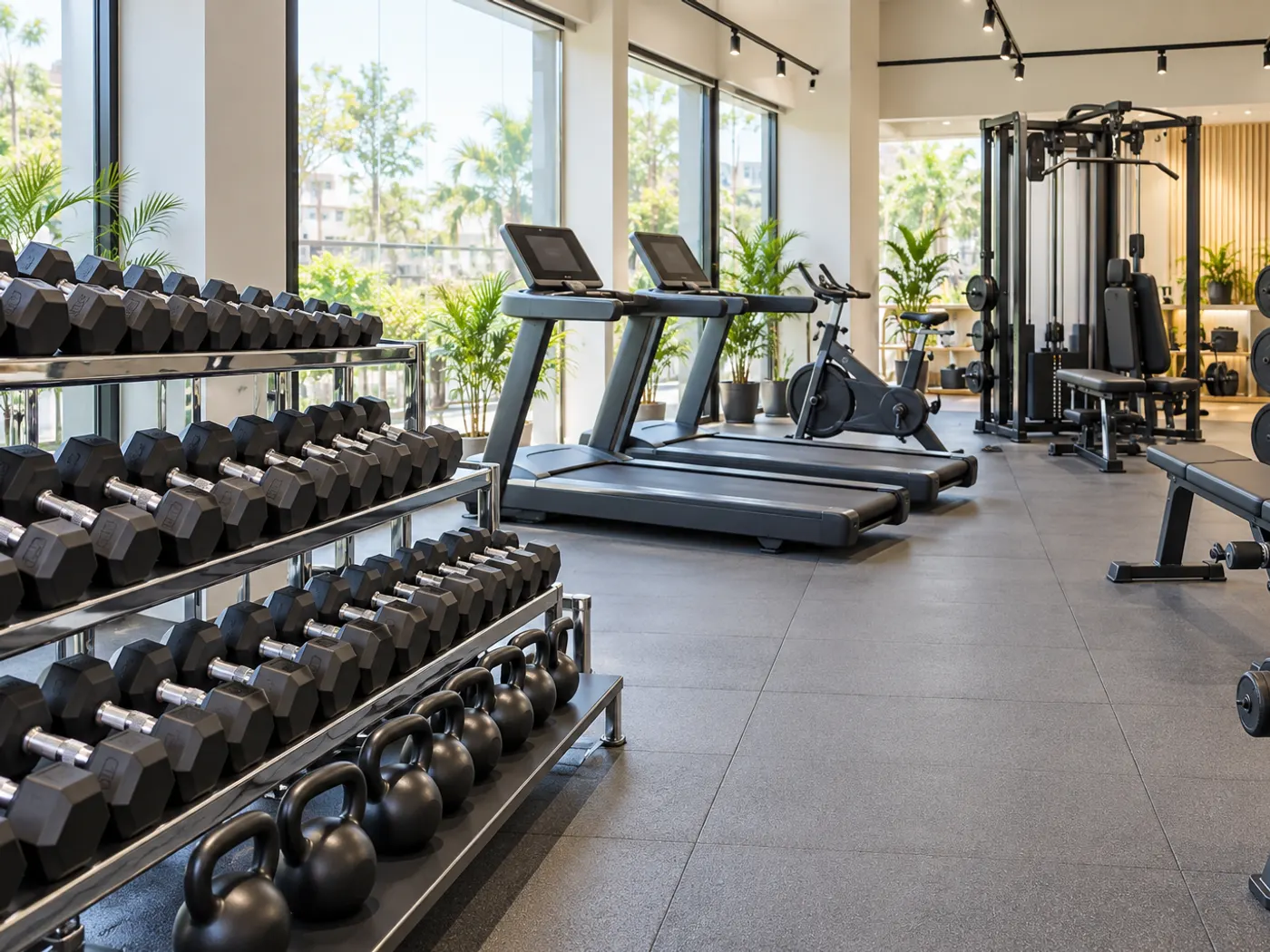
- Dumbbells, kettlebells, weight plates, benches and racks: usually 9506 at 18%.
- Treadmills, exercise cycles, ellipticals and rowers: usually 9506 at 18%, including when sold to a home buyer rather than a gym.
- Gym gloves: 5% applies to gloves specially designed for sports under 4203, which is the leather and composition leather heading. Gloves of fabric or synthetic material fall elsewhere; check the HSN rate with your CA.
- Gym bags: sports bags and rucksacks under 4202 are 18%.
- Mats, flooring, resistance bands, belts and shaker bottles: the heading depends on the material and design. Check the HSN rate with your CA before you price them.
How do you calculate GST on gym equipment?
Multiply the taxable value by the rate, then add it on; if a price already includes GST, divide by 100 plus the rate and multiply by the rate. Here is a worked example in units instead of rupees.
- Find the HSN and rate. A treadmill under 9506, as exercise equipment, is 18%.
- GST-exclusive price: on a taxable value of 100 units, GST is 18 units and the invoice total is 118 units.
- GST-inclusive price: if the quote is 118 units including GST, the tax is 118 × 18 ÷ 118 = 18 units, and the taxable value is 100 units.
- Split it: from a seller in the same state, 9 units CGST and 9 units SGST; from another state, 18 units IGST.
- Mixed orders: if the same invoice has a treadmill and a cricket kit, each line takes its own rate.
Now follow the same treadmill to two buyers. An equipment shop buying it for resale can, subject to the usual conditions, take the 18 units as input tax credit and set it off against GST on its own sale. If it sells for 130 units plus 18%, it collects 23.4 units and pays the government 5.4 units after credit. A gym charging 5% on membership cannot take that credit, so its real cost for the treadmill is 118 units, not 100.
Can a gym claim input tax credit on equipment?
In general, no, not for equipment used to run the gym service, because the 5% rate on gym services applies only if credit on inputs used for that service is not taken. The rate is mandatory, so a gym cannot switch back to 18% to recover the credit.
The general rule sits in Section 16 of the CGST Act: a registered person may take credit of input tax on goods or services used in the course or furtherance of business, subject to conditions such as holding a tax invoice, having received the goods, and the supplier’s details appearing in the return. Section 17 restricts credit where inputs are used partly for other purposes and lists blocked credits.
- Gym or fitness studio at 5%: GST on machines, free weights, flooring and repairs used for the gym service is a cost.
- Equipment dealer or online seller: credit on stock bought for resale is generally available, subject to Section 16 conditions.
- Gym that also sells supplements or apparel: ask your CA how credit on goods bought for resale is handled alongside the no-credit gym service.
- Depreciation: Section 16(3) says that if depreciation is claimed on the tax component of capital goods under the Income-tax Act, credit on that component is not allowed.
- Staff gym memberships: Section 17(5) blocks credit on membership of a club or health and fitness centre for most businesses, with limited exceptions.
What should gyms and equipment sellers check on every invoice?
Check that each line has the right HSN, rate and tax split, because a wrong code on a supplier’s invoice becomes your problem at audit. A simple checklist helps both sides.
- HSN on every line, matching the product, not just "gym items".
- Exercise equipment and sports goods on separate lines with their own rates.
- CGST and SGST for a seller in your state, IGST for a seller outside it.
- The seller’s GSTIN and your GSTIN, if you are registered.
- For a gym: equipment bills filed as costs, not as credit, unless your CA says otherwise.
- For a seller: product pages and quotes that say clearly whether prices include GST.
Shops selling equipment online should show the HSN, rate and GST-inclusive price on each product page; a well-built e-commerce website can store the HSN per product so invoices pick the right rate automatically.
How DVM Techno Can Help
DVM Techno is a web and software company in Gurgaon, with a branch in Kasni, Jhajjar. For gyms, we built Balvira gym management software, which issues GST invoices in an unbroken series, keeps counter sales of supplements and apparel with stock and their own receipt series, and records rent, salaries and equipment per branch so you can see what the lost credit costs. It keeps the records; your CA still decides the tax treatment. If you are comparing systems, our gym software buying guide lists what to check.
Frequently Asked Questions
What is the GST rate on gym equipment in India after 22 September 2025?
Articles and equipment for general physical exercise, gymnastics and athletics under HSN 9506, which usually covers treadmills, exercise cycles, dumbbells and weight machines, are in the 18% schedule of Notification No. 9/2025-Integrated Tax (Rate). Sports goods other than exercise equipment moved from 12% to 5%. Confirm the classification of each product with your CA, because the HSN decides the rate.
Is GST on dumbbells and treadmills 5% now?
No. The 5% rate from 22 September 2025 applies to sports goods other than articles and equipment for general physical exercise. Dumbbells, treadmills and exercise cycles are normally classified as equipment for general physical exercise, which the notification places at 18%. A seller charging 5% on them should be able to show why the product falls under a different heading.
What is the GST on gym supplements and protein powder?
It depends on the HSN. Food preparations not elsewhere specified under 2106 moved from 18% to 5% from 22 September 2025, while whey protein concentrates with more than 80% whey proteins under 3502 are in the 18% schedule. Check the HSN printed on your supplier’s invoice and confirm it with your CA before you set counter prices.
Can a gym claim input tax credit on equipment it buys?
Generally not for equipment used to supply the gym service. From 22 September 2025, gym and fitness services are taxed at a mandatory 5% on the condition that credit on inputs used for the service is not taken. So GST paid on machines and weights becomes part of the cost. An equipment dealer buying for resale can generally take credit under Section 16, subject to its conditions.
How do I calculate GST on a GST-inclusive equipment price?
Multiply the inclusive price by the rate and divide by 100 plus the rate. For an 18% item quoted at 118 units including GST, the tax is 118 × 18 ÷ 118, which is 18 units, and the taxable value is 100 units. Within your state, split the tax equally into CGST and SGST; from another state, it is charged as IGST.
Related articles
Want gym billing that keeps GST records straight?
See how Balvira, built by DVM Techno, handles GST invoices, counter sales with stock, and equipment costs per branch.