
Jhajjar District, Haryana
Village Website Design & Development in Haryana
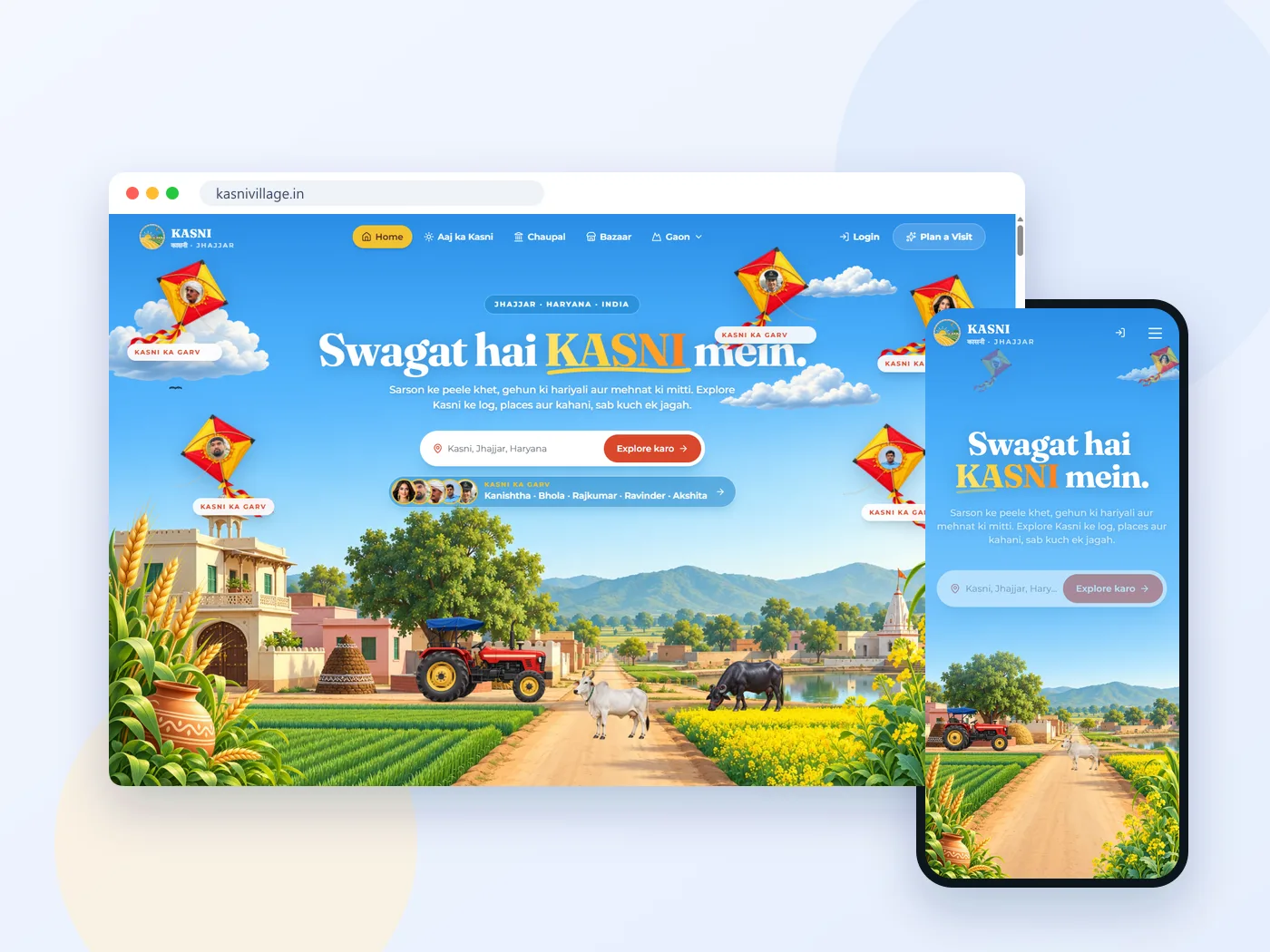
A website of your village's own: the gaon's profile and data, places and festivals, a daily page, a digital chaupal for notices, events and lost-and-found, a bazaar for local shops and services, and stories of the people who made the village proud. It is written in the language people speak, shares to WhatsApp and installs on a phone like an app.
- Village info, news & notice board
- Installs on a phone like an app
- Hindi, Haryanvi or Hinglish
Jhajjar
Built in a Jhajjar village.
Most of Haryana lives in its villages. The Tribune reported in February 2021 that the state had 6,222 gram panchayats for its 6,846 villages, before 106 more panchayats were notified. In Jhajjar district, the 2011 Census counted 958,405 people, and only about 22 per cent of them lived in towns. Yet most villages have no website of their own, so their news, notices and history live in WhatsApp forwards that are hard to find a week later.
Kasni, in Jhajjar tehsil, had 4,034 people in 769 households at the 2011 Census, and 550 of its workers were cultivators. kasnivillage.in, which DVM Techno built, gives the village one place for all of it: Census data with the source named, the school, canal and health sub-centre, festivals, a daily Aaj ka Kasni page, a Gaon ki Chaupal for notices, complaints, polls and lost-and-found, a Kasni Bazaar for local shops and workers, and Kasni ka Garv pages on people from the village. It installs as a progressive web app, which web.dev describes as an app launched from the home screen that keeps working on slow or flaky connections, and even offline.
A village website is a community site. It does not replace official systems: panchayat planning, progress tracking and accounts run on eGramSwaraj, the Ministry of Panchayati Raj platform built with NIC. Our branch is in Kasni, Jhajjar, and our main office is in Sector 84, Gurgaon, so we can sit with the people behind your village's site, in the village, before a single page is designed.
Sources: Census 2011 — Kasni village data (village code 061888) · The Tribune — 106 new panchayats notified (25 Feb 2021) · eGramSwaraj — Ministry of Panchayati Raj · web.dev — What are progressive web apps? · MeitY — Digital Personal Data Protection Act, 2023 · Wikipedia — Kasni, Jhajjar · Wikipedia — Jhajjar district
What a village website has to get right
- Nearly everyone opens it on a phone, often on a weak signal, so pages must be light and keep working once installed
- It must speak the village's language: Hindi, Haryanvi or Hinglish, with English only where it helps
- Someone in the village must be able to post a notice or news from a phone, without calling a developer
- Phone numbers in a bazaar listing or a blood-donor request are personal data, so they appear only with consent
- Sons and daughters of the village living in cities or abroad want the same news, so every update must share to WhatsApp
Village Website Design
What a village website can include in Jhajjar.
Sections we can build for your gaon, chosen with the people who will own and run the site. Start small and add sections later.
- Village profile & dataLocation, PIN code, tehsil and block, Census figures with the source named, nearby villages, and places such as the school, health sub-centre, bank and canal.
- Daily village pageA page that changes every day, such as weather, a word in the local dialect, panchang, news links, job alerts and a daily quiz, chosen by your village.
- Digital chaupal & notice boardNotices from the panchayat or village committee, events, complaints, lost and found, polls and greetings, posted from a phone by people you approve.
- Village bazaarLocal shops, craftsmen and people looking for work list themselves with call and WhatsApp buttons, with an approval step before a listing goes live.
- Installable phone appThe website installs from the browser like an app, with no Play Store download. It opens with one tap and can send a morning notification to people who allow it.
- Pride, history & photosStories of people from the village who made a name, the village's roots in farming, the forces or wrestling, festivals, and a gallery of old photos and memories.
Process
How the work runs.
The same clear steps for every Jhajjar project, with progress shared on WhatsApp.
- 01Meeting in the villageWe meet the people behind the site, such as the panchayat, a youth club or a samiti, and list what the village wants on it.
- 02Facts, photos & permissionsVillage data from the Census and official sources, places, festivals and photos collected, with consent for every profile and photo.
- 03Design & first versionPages designed in your village's language and look, and a first version shared on WhatsApp for feedback.
- 04Training the adminsThe people who will post notices, news and listings are trained on their own phones.
- 05Launch & supportDomain and hosting set up, the site submitted to Google Search, and support by phone and WhatsApp.
FAQs
Village Website Design in Jhajjar — FAQs.
Straight answers to what Jhajjar business owners ask before they start.
Is a village website the same as the official gram panchayat website?
No. Official panchayat planning, progress tracking and accounts are handled on eGramSwaraj, the Ministry of Panchayati Raj platform. A village website is the village's own community site. If the panchayat wants, it can post its notices there too, but the site does not replace any official record or government portal.
Who can get a village website made?
A gram panchayat, a village youth club, a samiti or trust, or people from the village living elsewhere who want to give something back to it. Before we start, we agree who will own the site and who will post updates on it.
Can the website be in Hindi or Haryanvi?
Yes. Kasni's site is written in Hinglish, the way people talk in the village, with Devanagari where it matters. A village website can be in Hindi, Haryanvi, Hinglish or English, or a mix of them.
Do villagers have to download an app from the Play Store?
No. The website can be installed straight from the browser as a progressive web app. It then opens from the phone's home screen like any app, and pages already opened keep working when the signal drops.
Who updates the notices, news and bazaar?
People the village chooses, for example the panchayat secretary, a teacher or a youth volunteer, get their own logins and post from a phone. We train them, and support is by phone and WhatsApp.
How are villagers' phone numbers and photos handled?
Names, phone numbers and photos of people are personal data under the Digital Personal Data Protection Act, 2023. They should be published only with the person's consent and removed when they ask. The site can show a listing only after approval and hide numbers behind a call button. This is general information, not legal advice.
Can people living outside the village follow the news?
Yes. Every page and notice has a WhatsApp share button, and a daily summary can be posted to a WhatsApp channel, so people in cities or abroad stay in touch with the gaon.
Will the village website show up on Google?
We build pages that search engines can read, add the village's place details and submit the site to Google Search. Where it appears depends on what people search for and on Google, so no one can promise a position.
Who owns the domain and the content?
The stories, photos and village data belong to the village. Ownership of the domain and hosting is agreed with whoever commissions the site and set out in the project agreement.
Village Website Design for Your Jhajjar Business
Call or WhatsApp +91-8448523313 · Mon–Sat, 9 AM – 7 PM · info@dvmtechno.com