
On this page
- Is there a CCTV law in India?
- Which laws apply to CCTV footage?
- When is CCTV compulsory in India?
- What are the CCTV rules for a home?
- What are the CCTV rules for a housing society, and what if a neighbour’s camera faces your house?
- What are the CCTV rules for schools and workplaces?
- Quick reference: what to do in common situations
- How DVM Techno Can Help
- FAQs
Key takeaways
- There is no single CCTV law in India; privacy rights, the DPDP Act, 2023, the IT Act and state or sector rules together decide what is allowed.
- Cameras in a home used only for personal or domestic purposes fall outside the DPDP Act, but pointing one into a neighbour’s home can still breach their privacy.
- Societies, schools and employers should record only common or work areas, put up clear notices, limit who views footage and delete it on a fixed schedule.
- Some places must install CCTV under specific rules, such as CBSE-affiliated schools, police stations and covered establishments in states like Karnataka.
Is there a CCTV law in India?
No. India has no single law that governs CCTV cameras. Instead, several laws and rules apply at the same time, depending on who installs the camera, where it points and what happens to the footage.
- The right to privacy: a fundamental right recognised by the Supreme Court in 2017.
- The Digital Personal Data Protection Act, 2023: for digital footage of people who can be identified.
- The Information Technology Act, 2000: Section 66E on capturing images of private areas.
- Criminal law: Section 77 of the Bharatiya Nyaya Sanhita, 2023 on voyeurism.
- State laws, board rules and court orders: which make CCTV compulsory in certain places.
- Private rules: society bye-laws, general body decisions and company policies.
So the practical question is not “is CCTV legal?” but “is this camera, in this spot, recording these people, reasonable and properly managed?”
Which laws apply to CCTV footage?
Privacy is the base layer, the DPDP Act covers how identifiable footage is handled, and the IT Act and criminal law punish recording private areas.
In Justice K.S. Puttaswamy (Retd.) v. Union of India, decided on 24 August 2017, a nine-judge bench of the Supreme Court held that privacy is a fundamental right protected under Article 21 and Part III of the Constitution. The judgment binds the State, but it shapes how courts look at any surveillance, including private cameras.
The DPDP Act, 2023 defines personal data in Section 2(t) as data about an individual who is identifiable by or in relation to it. Digitally recorded footage of a recognisable person fits that wording, although the Act never mentions CCTV by name. Key sections for camera owners:
- Section 3(c)(i): the Act does not apply to personal data processed by an individual for a personal or domestic purpose.
- Section 7(i): employers may process data for employment purposes or to safeguard themselves from loss or liability.
- Section 8(5): take reasonable security safeguards to prevent a personal data breach.
- Section 8(7): erase personal data once its purpose is served, unless a law requires you to keep it.
Most duties under the DPDP Rules, 2025 start after an 18-month phased timeline, as described in the PIB release of 14 November 2025. Separately, Section 66E of the IT Act makes it an offence to capture or share images of a person’s private area without consent where they reasonably expect privacy, and Section 77 of the Bharatiya Nyaya Sanhita covers watching or recording a woman during a private act.
When is CCTV compulsory in India?
CCTV is compulsory only where a specific law, rule, licence condition or court order says so. There is no national rule that makes every shop, home or office install cameras.
- Police stations: in Paramvir Singh Saini v. Baljit Singh (December 2020), the Supreme Court directed CCTV with night vision and audio at entry and exit points, lock-ups, corridors and other areas of every police station, with footage kept for 18 months, or at least one year where equipment cannot manage that. It also covered offices of central agencies such as the CBI, NIA and ED.
- CBSE schools: clause 4.7.10 of the CBSE Affiliation Bye-Laws, added in July 2025, requires audio-visual CCTV across the campus, excluding toilets and washrooms, with at least 15 days of stored footage.
- State public safety laws: for example, the Karnataka Public Safety (Measures) Enforcement Act, 2017 requires establishments where 100 or more people gather at a time, or 500 a day, to provide access control and CCTV and to store footage for 30 days or as notified.
Rules differ by state, city and licence. Before you open a shop, hotel, hospital, factory or school, ask the local police station and your licensing authority whether CCTV is a condition for you.
What are the CCTV rules for a home?
You can install CCTV on your own home, but aim it at your own property, not into a neighbour’s home or private spaces. A camera used only for household safety is likely a personal or domestic purpose under Section 3(c)(i) of the DPDP Act, so most of that Act will not apply. Privacy law still does.
- Point cameras at your gate, door, parking spot, terrace access and boundary wall.
- Keep neighbours’ windows, doors and balconies out of frame, or use privacy masking in your recorder.
- Never place cameras in bathrooms or in rooms used by domestic staff to change or rest.
- Tell domestic workers and tenants that cameras are installed and where.
- Think twice before posting clips of other people on social media; sharing can go beyond a domestic purpose.
For camera choice and placement around a house, see our home CCTV security guide.
What are the CCTV rules for a housing society, and what if a neighbour’s camera faces your house?
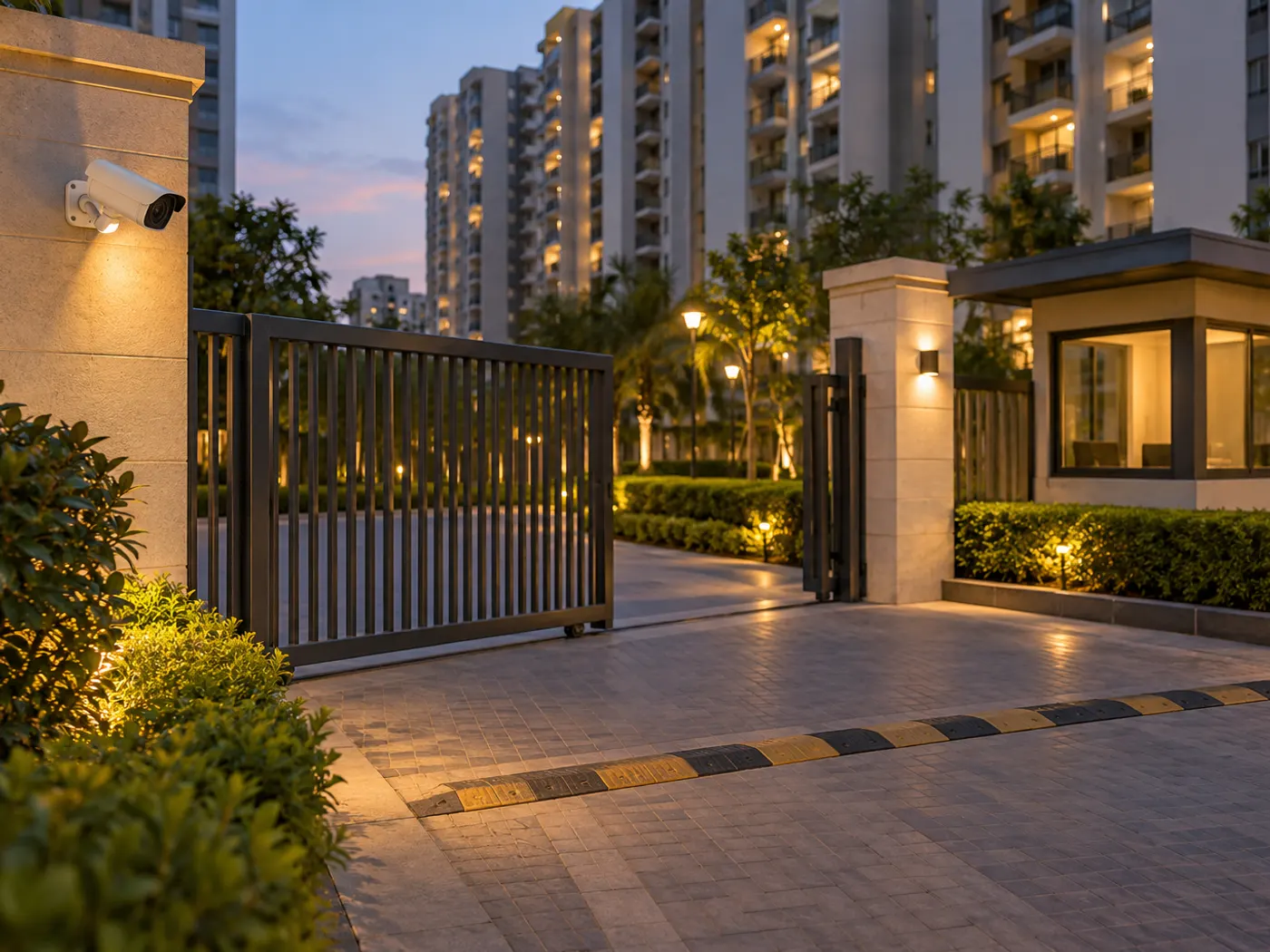
A society should install cameras only in common areas, on a decision of its general body or managing committee, with notices and written rules for viewing footage. Check your society’s registered bye-laws, because they decide who can approve spending and policies.
- Decide openly: pass a resolution that lists camera locations, purpose and who manages the system.
- Cover common areas only: gates, lobbies, lifts, parking, stairwells, the boundary and the clubhouse entrance.
- Avoid private views: no camera should look into a flat’s door, window or balcony.
- Put up notices at every entrance and in lifts.
- Limit access: the guard sees live view; only named office bearers can play back or export.
- Handle requests in writing: residents and police should ask in writing, and the society should log what it shared.
If a neighbour’s camera points straight into your home, start by asking them to re-aim it or mask the view. If that fails, write to the RWA or society committee. If the camera captures private moments, or the footage is used to harass you, file a police complaint. A civil court can also be asked to order the camera moved.
What are the CCTV rules for schools and workplaces?
Schools and employers can use CCTV for safety and security, but must keep it out of toilets and changing areas, tell people about it and control who sees the footage.
For CBSE schools, the bye-law clause above sets coverage and storage, and our school CCTV installation guide explains it area by area. Other boards and state schools should follow their own circulars and treat student footage with extra care, because it shows children.
At work, Section 7(i) of the DPDP Act lets an employer process data for employment and to protect against loss or liability. That does not mean any camera anywhere is fine. Cover entrances, cash, stores, server rooms and shop floors; tell staff in writing what is recorded and why; and keep cameras out of restrooms, changing rooms and prayer rooms. Our office CCTV guide covers placement, and our guide to CCTV in clinics covers patient areas.
Be careful with audio. A microphone records conversations, not just movement, and captures far more personal detail. Keep audio off unless a specific rule, such as the CBSE bye-law, requires it, or a lawyer has advised it.
Quick reference: what to do in common situations
Use this table as a starting checklist, then confirm the details for your state and premises.
| Situation | What to do | Why |
|---|---|---|
| Camera on your own house | Aim at your gate, door and parking; mask neighbours’ windows | Domestic use is outside most of the DPDP Act, but privacy still applies |
| Neighbour’s camera looks into your home | Ask to re-aim, then write to the RWA, then police or civil court | Your home is a place where you reasonably expect privacy |
| Society installing cameras | General body or committee resolution, common areas only, notices | Residents’ consent and bye-laws give the system legitimacy |
| Office, shop or factory | Written staff notice, no cameras in restrooms or changing rooms | DPDP Act Section 7(i) allows employment use, not unlimited use |
| CBSE-affiliated school | Audio-visual CCTV in required areas, at least 15 days storage, none in toilets | Clause 4.7.10 of the Affiliation Bye-Laws |
| Large establishment in Karnataka | Access control and CCTV, footage kept 30 days or as notified | Karnataka Public Safety (Measures) Enforcement Act, 2017 |
| Police ask for footage | Ask for a written request, export only the clip asked for, log the hand-over | Keeps a clean record and limits what leaves your premises |
| Old footage piling up | Fix a retention period and let the recorder overwrite | DPDP Act Section 8(7) asks for erasure once the purpose is served |
This is general information, not legal advice. Ask a lawyer how these laws apply to your home, society, school or business.
How DVM Techno Can Help
DVM Techno makes DVM VigiCore, on-premise video management software for Windows. Footage stays on disks inside your building, roles and an editable permission matrix decide who can view, play back or export, an audit log shows what was done, and the oldest footage is recycled automatically to keep the free space you set. Lossless clip export helps when police ask for a specific incident. The free download works with up to 4 cameras. Our Kasni team also offers CCTV installation around Kasni and Jhajjar. Call +91-8448523313.
Frequently Asked Questions
Is there a CCTV law in India?
No single law covers CCTV in India. The right to privacy, the Digital Personal Data Protection Act, 2023, Section 66E of the IT Act and voyeurism under the Bharatiya Nyaya Sanhita all apply, along with state laws, board rules such as CBSE’s bye-laws and court orders that make cameras compulsory in certain places. Society bye-laws and company policies add their own rules on top.
Is it legal to install CCTV at home in India?
Yes, you can install CCTV on your own home. Processing for a personal or domestic purpose is outside the DPDP Act under Section 3(c)(i), but you should still aim cameras at your own gate, door and parking, keep neighbours’ windows and doors out of view, avoid bathrooms and tell domestic workers about the cameras. Posting clips of others online can cause problems.
What can I do if my neighbour’s CCTV camera faces my house?
Ask your neighbour politely to re-aim the camera or mask your windows and door in the recorder. If they refuse, write to your RWA or society committee. If the camera records private moments or the footage is used to harass you, file a police complaint. You can also ask a civil court to order the camera moved. Keep photos of the camera angle as a record.
Can my employer install CCTV at my workplace?
Generally yes. Section 7(i) of the DPDP Act allows employers to process personal data for employment purposes and to protect against loss or liability. Cameras should cover work areas such as entrances, cash counters, stores and shop floors, never restrooms or changing rooms, and staff should be told in writing what is recorded and why. Audio recording needs extra caution and legal advice.
How long should CCTV footage be kept in India?
There is no single national period for private premises. Specific rules set their own: CBSE schools must store at least 15 days, Karnataka’s public safety law asks covered establishments for 30 days or as notified, and police stations must keep footage for 18 months under the Supreme Court’s 2020 order. Elsewhere, fix a period in writing and let the recorder overwrite older footage.
Related articles
Keep control of who sees your footage
Try DVM VigiCore free with up to 4 cameras, with local recording, roles and an audit log on your own Windows PC.