
On this page
- What are the school bus rules and regulations in India?
- What did the Supreme Court direct for school buses?
- What do CBSE’s rules and Haryana’s Surakshit School Vahan Policy add?
- School bus rules at a glance: bus, driver, attendant, students, parents, school
- What are the school bus rules for drivers?
- What are the school bus rules for students?
- Where can you get the official school bus rules PDF?
- How DVM Techno Can Help
- FAQs
Key takeaways
- School bus rules in India come in layers: the Motor Vehicles Act and central rules, Supreme Court directions, board rules such as CBSE’s, and state policies.
- The Supreme Court’s December 1997 order in M.C. Mehta v. Union of India set core rules: closable doors, a qualified conductor, no more than 1.5 times seating capacity and drivers with five years’ heavy-vehicle experience.
- CBSE’s Annexure IX adds the familiar list: a uniform colour (preferably yellow), “School Bus” marking, window grills, a 40 km/h speed control device, a fire extinguisher, a first aid box and an attendant.
- Haryana’s Surakshit School Vahan Policy dates from 2014; a 2024 draft adds a twice-yearly self-certification affidavit by schools, but check its final status with the Transport Department.
What are the school bus rules and regulations in India?
School buses in India must follow four layers of rules: the Motor Vehicles Act, 1988 and the Central Motor Vehicles Rules, Supreme Court directions from 1997, the rules of the school’s board (such as CBSE’s transport precautions), and the state’s own school vehicle policy.
- Central law: the Motor Vehicles Act covers licences, fitness and permits. Rule 118 of the Central Motor Vehicles Rules requires speed governors in transport vehicles, with limits notified by states.
- Tracking and panic buttons: Rule 125H requires a tracking device and emergency buttons in many public service vehicles. Our AIS-140 guide for Haryana schools explains when it applies to a school bus.
- Court directions: the Supreme Court’s 1997 orders in the M.C. Mehta case.
- Board and state rules: CBSE’s bye-laws and state policies such as Haryana’s add detailed checklists.
What did the Supreme Court direct for school buses?
In M.C. Mehta v. Union of India, a case on road safety in Delhi, the Supreme Court’s judgment of 16 December 1997 laid down rules for buses used by educational institutions. These directions are what people usually mean by the “Supreme Court guidelines for school buses”.
- Doors: no bus may be used by an educational institution unless it has doors that can be closed.
- Conductor: a qualified conductor must be present at all times.
- Parents on board: schools were asked to arrange, as far as possible, for at least one parent to travel in each bus to oversee the driver.
- Seating: no bus may carry children beyond 1.5 times its registered seating capacity.
- Drivers: at least five years of experience driving heavy vehicles, and a clean challan record (details in the driver section below).
- Uniform and marking: drivers in a distinctive uniform, and a suitable inscription showing the bus is on the duty of an educational institution.
The judgment also refers to an earlier November 1997 order on speed control devices. Popular lists of “Supreme Court guidelines” add yellow paint, first aid boxes, window grills and fire extinguishers. We could not find those in the December 1997 judgment itself; they appear in CBSE’s rules and state policies.
What do CBSE’s rules and Haryana’s Surakshit School Vahan Policy add?
CBSE made transport precautions part of its affiliation bye-laws in 2012, and Haryana has its own Surakshit School Vahan Policy for school vehicles. A Haryana CBSE school must meet both.
CBSE Circular No. 01/2012 (8 June 2012) says the issue had been raised by parents, transport departments and the Supreme Court. Schools must submit a transport safety certificate from the authority with their affiliation application and renew it every five years. Its Annexure IX lists the precautions in the table below. A 2016 CBSE circular changed the teacher-on-board rule to “at least one lady attendant / lady guard in each school bus”. Our CBSE school bus safety norms guide covers the later circulars.
Haryana’s Surakshit School Vahan Policy dates from 2014. In July 2024, after a school bus crash in Mahendragarh, the Transport Department circulated a draft Surakshit School Vahan Policy, 2024 for comments, as The Tribune reported. It covers school-owned buses and vehicles run by a third party for the school. Its main additions:
- State, district and sub-division committees that inspect every school vehicle at least once a year and report monthly.
- A notarised self-certification affidavit from each school on 1 January and 1 July every year.
- An inspection form that checks, among other items, a working speed governor, a location tracking device, IP cameras with at least 15 days’ recording, HSRP number plates, no tinted glass or curtains, and a lady or transgender attendant when girls are carried.
We could not confirm on official websites whether the 2024 draft has been finally notified. Ask your District Transport Officer which version your vehicles are inspected against.
School bus rules at a glance: bus, driver, attendant, students, parents, school
Most rules fall on the school and the operator, but students and parents have a part too. It combines the 1997 judgment, CBSE Annexure IX and Haryana’s 2024 draft; the student and parent rows are good practice, not law.
| Who | Key rules | Source |
|---|---|---|
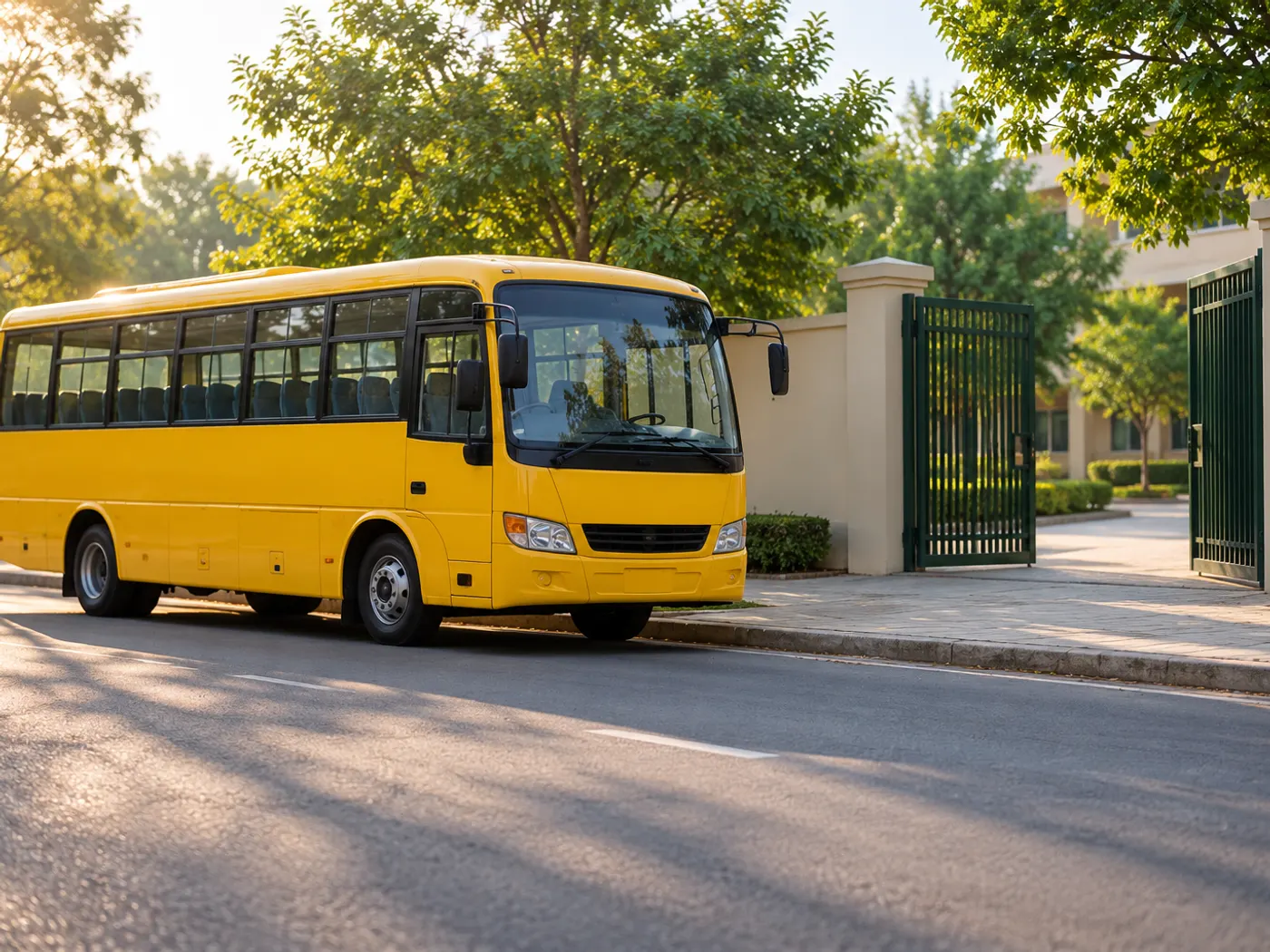
| The bus | Uniform colour, preferably yellow; school name on both sides; “School Bus” front and back (“On School Duty” if hired); school phone number displayed; horizontal window grills with mesh; lockable doors; speed control device (40 km/h); fire extinguisher; first aid box; alarm bell or siren; space for bags; valid fitness certificate | CBSE Annexure IX; Supreme Court 1997 |
| The driver | Valid licence; 5+ years on heavy vehicles; clean challan record; yearly medical and eye test; refresher training twice a year; never under alcohol; uniform with name | Supreme Court 1997; CBSE; Haryana draft |
| The attendant | Qualified attendant or conductor on every trip; lady attendant or lady guard; uniform with name; trained to handle children | Supreme Court 1997; CBSE 2012 and 2016; Haryana draft |
| Students | Board and get off in a line; stay seated; keep hands and head inside; keep the aisle clear; follow the attendant | School transport policy; CBSE asks schools to keep discipline at boarding |
| Parents | Be at the stop on time; share the correct stop and contacts; report concerns to the transport manager | Good practice; Haryana draft asks schools to take parents’ feedback |
| School | Name a Transport Manager; safe boarding, inside the campus where possible; designated stops only; a mobile phone in each bus; records of checks and feedback; yearly affidavit in Haryana (draft) | CBSE; Haryana draft |
What are the school bus rules for drivers?
A school bus driver needs a valid licence for the vehicle, at least five years of heavy-vehicle experience, a clean challan record, yearly medical checks and regular refresher training. The full list:
- Licence and age: a valid driving licence for the vehicle class. Section 4(2) of the Motor Vehicles Act sets 20 years as the minimum age for driving a transport vehicle.
- Experience: at least five years of driving heavy vehicles (Supreme Court 1997, CBSE, Haryana draft).
- Challan record: not challaned more than twice in a year for offences such as red-light jumping, and never for over-speeding, drunken or dangerous driving, or rash driving offences under criminal law.
- No alcohol or drugs: regular checks by the school; Haryana’s draft requires immediate termination.
- Medical fitness: a check-up including an eye test every year (CBSE).
- Refresher training: at least twice a year.
- Police verification: Haryana’s draft asks for verification of drivers, conductors and attendants within 20 days of joining.
- On the road: stay within the speed governor limit, keep doors shut while moving, stop only at designated stops and do not overtake other four-wheelers with children on board (CBSE). Using a handheld phone while driving counts as dangerous driving under Section 184 of the Motor Vehicles Act, as amended in 2019.
- Identity: a distinctive uniform with name, and an RTA-certified photograph of the driver in the vehicle (CBSE).
Our post on rash driving by school bus drivers covers how schools can monitor speed.
What are the school bus rules for students?
Rules for students are mostly about behaviour at the stop, while boarding and during the ride. CBSE asks schools to make sure students keep discipline while boarding and getting off. Print this list in the school diary:
- Reach the stop early, wait well back from the road and board only after the bus stops fully.
- Board and get off in a line, without pushing; hold the handrail.
- Stay seated while the bus moves; do not change seats or stand in the aisle.
- Keep hands, head and bags inside the windows.
- Talk quietly; never shout, fight or distract the driver.
- Follow the attendant’s instructions at all times.
- Get off only at your own stop; if you miss it, tell the attendant.
- Never cross in front of or behind the bus; wait until it leaves or the attendant helps you cross.
- Tell the attendant at once if you feel unwell or see something unsafe.
Safe boarding also depends on the gate. Our school drop-off zone plan shows how to give buses their own bay.
Where can you get the official school bus rules PDF?
Use the issuing authority’s own documents, not forum copies.
- CBSE transport precautions: Circular No. 01/2012 with Annexure IX on cbse.gov.in.
- CBSE lady attendant change: the 2016 circular on CBSE’s SARAS portal.
- Haryana: the draft Surakshit School Vahan Policy, 2024, with its inspection and self-certification formats, as circulated by the Higher Education Department. For the final version, ask the Transport Commissioner’s office or your District Transport Officer.
- Supreme Court: search the Court’s judgment portal for M.C. Mehta v. Union of India, decided 16 December 1997.
This post is general information, not legal advice. Rules change and differ by state and board, so confirm the current position with your RTO, DTO or board before acting.
How DVM Techno Can Help
DVM Techno is a software company with its team in Gurgaon, Haryana. Our SchoolTrack school bus tracking app turns the driver’s phone into a tracker. Parents see the bus live and get an alert when it is about 500 m away. Children scan a QR code or RFID card as they board, and a one-tap SOS alerts the school, parents and emergency contacts. SchoolTrack does not make a bus compliant with any rule above and is not an AIS-140 device; it helps your transport manager see each trip as it happens. Call +91-8448523313 for a demo.
Frequently Asked Questions
What are the Supreme Court guidelines for school buses in India?
In M.C. Mehta v. Union of India, the Supreme Court’s order of 16 December 1997 said buses of educational institutions must have closable doors and a qualified conductor at all times. They may not carry children beyond 1.5 times seating capacity. Drivers need five years’ heavy-vehicle experience and a clean challan record, a distinctive uniform, and the bus needs an inscription showing it is on school duty.
Is it compulsory for school buses to be yellow in India?
CBSE’s transport precautions say school buses must be painted a uniform colour, preferably yellow, with the school’s name on both sides and “School Bus” written on the front and back. A hired bus must show “On School Duty”. Many state policies follow the same pattern. Check your own board’s and state’s current rules, because the exact wording differs between them.
What is the speed limit for school buses in India?
CBSE asks affiliated schools to fit speed control devices so buses do not exceed 40 km/h. Separately, Rule 118 of the Central Motor Vehicles Rules requires speed governors in transport vehicles, with states notifying the limit; West Bengal, for example, set 60 km/h for school buses. Ask your RTO which limit applies; for a CBSE school, the board’s 40 km/h figure is the stricter one.
Who is responsible for school bus safety, the school or the operator?
Both. A 2016 CBSE circular makes the principal and the secretary of the school’s society or trust responsible for strict compliance with its transport guidelines. Haryana’s 2024 draft policy gives schools duties such as naming a Transport Manager and filing a self-certification affidavit. It makes operators responsible for hiring trained staff, police verification and driver refresher training. Put these duties in writing in every transport contract.
Is there an official PDF of the school bus rules for Haryana?
Yes, the draft Surakshit School Vahan Policy, 2024 was circulated as a PDF by the Haryana Higher Education Department, with inspection and self-certification formats attached. It would replace the 2014 policy. We could not confirm whether the final version has been notified, so ask the Transport Commissioner’s office or your District Transport Officer which version is used for inspections.
Related articles
See every school bus trip as it happens
SchoolTrack gives parents a live bus map and arrival alerts, and gives your transport manager trip history, attendance and SOS alerts on one dashboard.