
On this page
- Why does traffic jam at Indian school gates?
- What should a safe drop-off zone layout look like?
- How do one-way flow and a kiss-and-ride lane work?
- How do staggered dismissal, marshals and small-child handover help?
- What do the rules say about school transport and the gate?
- How can live bus tracking stop buses queuing at the gate?
- Step-by-step: how to implement a drop-off zone
- How DVM Techno Can Help
- FAQs
Key takeaways
- A drop-off zone works when each mode has its own place: buses in a bay, cars in a moving kiss-and-ride lane, two-wheelers and autos in separate spots, and walkers on a protected path.
- One-way flow, a no-parking rule near the gate and staggered dismissal by class remove most of the stop-start that causes the jam.
- Marshals, a handover rule for small children and early parent communication matter as much as cones and paint.
- Live bus tracking lets the office time bus arrivals so buses do not queue at the gate behind cars.
Why does traffic jam at Indian school gates?
Because every vehicle tries to stop at the same few metres of road at the same time. A bus, a car that double-parks, a scooter that cuts in and an auto unloading six children all block one another, and the queue spills onto the main road.
On busy stretches in Gurgaon, such as Sohna Road, Golf Course Road or the DLF phases, a school gate often opens straight onto a road carrying office traffic at the same hour. The usual causes are easy to spot:
- One shared kerb: buses, cars, two-wheelers and autos all use the same stretch outside the gate.
- Parked cars: parents park to walk children in, which turns a moving lane into a parking lot.
- U-turns and reversing: vehicles turn around in front of the gate, against the flow.
- Everyone at once: all classes start and finish at the same minute.
- Buses arriving together: several buses reach the gate within the same few minutes and wait behind cars.
What should a safe drop-off zone layout look like?
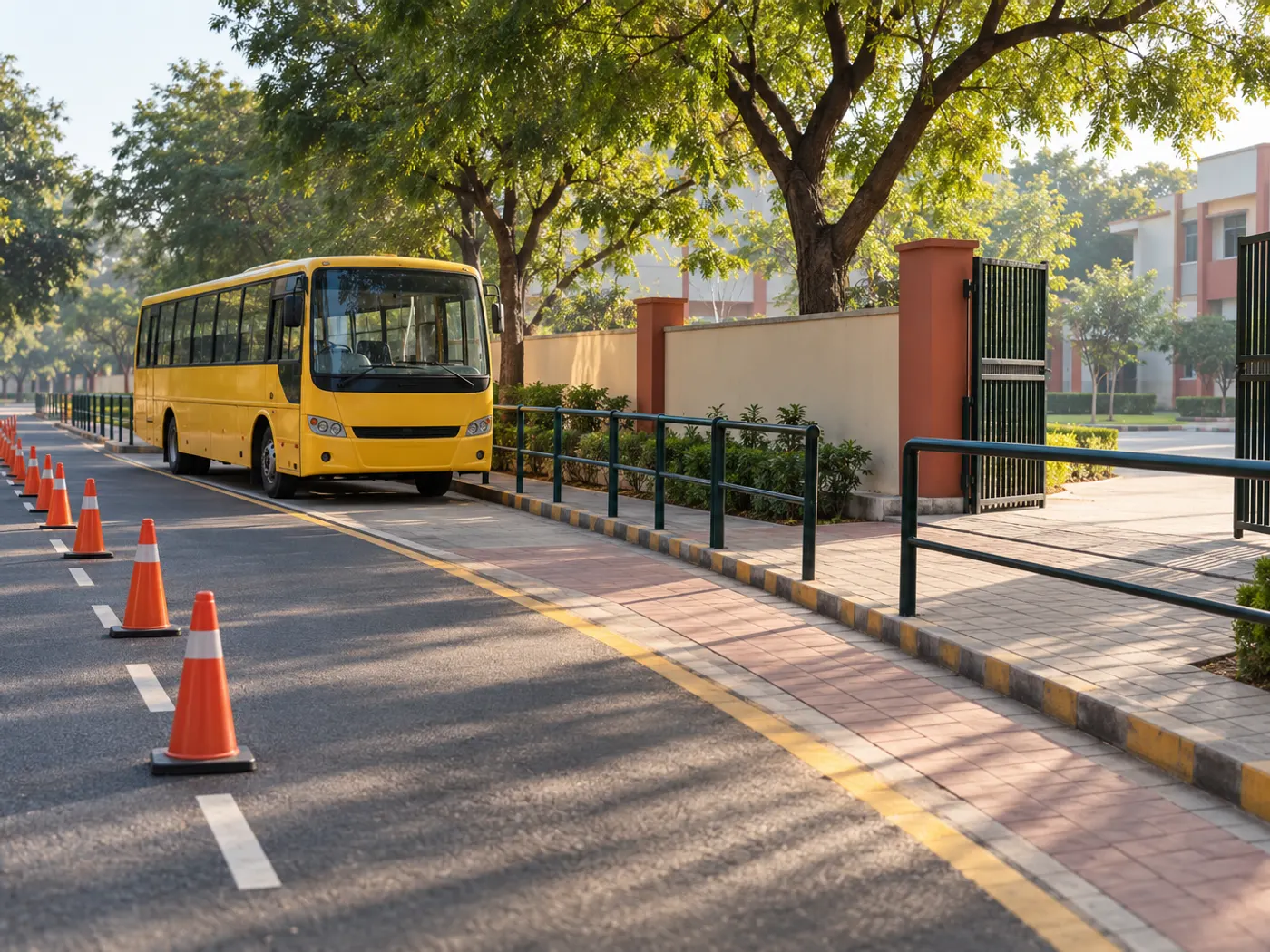
Give each mode of travel its own place, and keep children on foot away from moving vehicles. Where the campus has space, move bus drop-off inside the gate. Where it does not, use the road frontage in a fixed order.
| Zone | Who uses it | Where to place it | Rule |
|---|---|---|---|
| Bus bay | School buses and hired buses | Inside the campus, or the kerb nearest the gate | Buses only; children step straight onto the footpath or campus |
| Kiss-and-ride lane | Cars | A one-way lane after the bus bay | Stop, child gets out on the kerb side, drive on; no parking |
| Two-wheeler point | Scooters and bikes | A marked spot away from the bus bay | Engine off while the child gets down |
| Auto and van point | Autos and private vans | A separate stretch, not in the car lane | Children get down on the kerb side only |
| Walkers' path | Children walking or cycling | A protected footpath or barricaded lane to the gate | No vehicle crosses it during drop-off |
| Waiting area | Small children at pick-up | Inside the gate, under a shed | Child leaves only with the registered adult or bus attendant |
Draw the layout on a printed map of your gate and road before buying a single cone. Mark where each vehicle enters, stops and leaves, and check that no line crosses the walkers' path.
How do one-way flow and a kiss-and-ride lane work?
Vehicles enter from one side, stop briefly, let the child out on the kerb side and leave from the other side, without turning around. The lane keeps moving because no car waits longer than a quick goodbye.
- Fix one direction of travel for the drop-off hour and tell parents which road to approach from.
- Mark three to four car-length stopping points so several cars unload at the same time.
- Children get out only on the kerb side. Older children carry their own bags, so nobody opens the boot.
- A parent who needs to talk to a teacher parks away from the gate and walks in.
- No U-turns or reversing within sight of the gate.
If the gate opens onto a two-way main road, a full one-way loop may need permission. That is the point where you bring in the local traffic police.
How do staggered dismissal, marshals and small-child handover help?
Staggered timings spread the crowd, marshals keep the lane moving, and a handover rule makes sure no small child walks out alone. These are people-based measures and cost little beyond planning.
- Staggered dismissal: release pre-primary and primary a few minutes before senior classes, or release bus students first and car students after the buses leave.
- Marshals: post staff or trained parent volunteers in reflective jackets at the bus bay, the start of the car lane, the walkers' crossing and the gate. One person leads and can stop traffic with a whistle.
- Car door helpers: a marshal opens the car door and walks the child to the footpath, so parents do not get out.
- Small children: nursery and primary children wait inside the gate and are handed only to a registered parent or the bus attendant. Keep a printed list of authorised adults at the gate.
- Siblings: let the younger child leave with the older sibling's batch so families make one trip.
Handover on the bus side matters too. Our guide to children getting off at the wrong bus stop covers stop-side checks that pair well with a gate plan.
What do the rules say about school transport and the gate?
We did not find one national standard for designing a school drop-off zone in India, so treat layout as a local decision made with your traffic police. Bus safety rules do exist and shape how children get on and off.
- Supreme Court school bus guidelines: a March 2024 notice on the Doda district website lists guidelines it says were laid down by the Supreme Court, including that there must be a qualified attendant in the bus to attend to children, and that a parent, guardian or teacher may also travel to ensure safety norms.
- Haryana: a Tribune report of July 2024 on the reworked Surakshit School Vahan Policy, then a draft open for comments, says schools are to gather feedback from students and parents on drivers, conductors and attendants, and should encourage a staff member or a parents' association representative to travel with children.
- Local safe school zones: some cities have tried it. A December 2022 Pune report describes a municipal safe school zone where traffic is controlled at drop-off and pick-up times and traffic police are posted on the roads approaching the school.
Rules change and vary by state, so confirm the current position with your district transport authority before you finalise the plan. This is general information, not legal advice.
How can live bus tracking stop buses queuing at the gate?
When the office can see where every bus is, it can space arrivals and open the bus bay just in time, instead of letting buses wait on the road. This is where software helps a physical plan.
With SchoolTrack, our school bus tracking software, the transport in-charge sees every bus on one browser dashboard, and a geofence alert fires when a bus reaches the school gate. Trip history shows departure, stops and arrival for each trip, so you can see which buses keep arriving together and adjust their start times. Parents get an alert when the bus is about 500 m from their stop, and children scan a QR code or RFID card as they board and get off. Drivers have a one-tap SOS button.
If buses are arriving full and late because routes are stretched, read our guide on overcrowded school buses, and see school bus geofencing explained for how gate alerts work.
Step-by-step: how to implement a drop-off zone
Observe for a week, design on paper, agree with the police, tell parents, run a trial and then review. Follow this order:
- Observe: for five school days, note where each vehicle stops, where the queue starts and when it peaks.
- Count modes: ask class teachers how each child arrives: bus, car, two-wheeler, auto or van, or on foot.
- Design the layout: place the bus bay, kiss-and-ride lane, two-wheeler and auto points and the walkers' path on a map.
- Talk to the traffic police: share the map, ask about one-way timings, no-parking near the gate and a constable at peak minutes.
- Set timings: fix staggered entry and dismissal by class and space bus arrivals using trip history.
- Train marshals: assign posts, jackets and whistles, and brief them on the small-child handover rule.
- Tell parents: send the map and rules on WhatsApp and in the diary at least a week before the start.
- Trial run: run for two weeks with extra marshals, then fix the points where traffic still stops.
- Review each term: repeat the observation after new admissions or a timing change.
| Checklist item | Done? |
|---|---|
| Bus bay marked, buses only, children step onto footpath or campus | ☐ |
| One-way kiss-and-ride lane with fixed stopping points | ☐ |
| Separate two-wheeler and auto/van points | ☐ |
| Protected walkers' path with no vehicle crossing | ☐ |
| No parking, no U-turn rule near the gate | ☐ |
| Staggered entry and dismissal by class | ☐ |
| Marshals posted, briefed and in reflective jackets | ☐ |
| Small children handed only to registered adults or the bus attendant | ☐ |
| Traffic police consulted for timings and support | ☐ |
| Parents sent the map and rules | ☐ |
| Bus arrivals spaced using live tracking and trip history | ☐ |
How DVM Techno Can Help
DVM Techno is a software company based in Gurgaon, and SchoolTrack serves schools across India. It runs on the driver's phone with no GPS device, and gives parents live bus location and arrival alerts, with QR/RFID attendance and a driver SOS button. If you also use our School ERP for admissions, fees and attendance, SchoolTrack can connect with it. Call +91-8448523313 for a demo.
Frequently Asked Questions
What is a kiss-and-ride lane at a school?
A kiss-and-ride lane is a one-way drop-off lane where parents stop briefly, let the child out on the kerb side and drive on without parking. Several cars unload at once at marked points, and a marshal helps children to the footpath. Because no car waits, the queue keeps moving and does not spill onto the main road outside the school gate.
Should school buses and cars use the same drop-off point?
No. Buses and cars should have separate places. Ideally the bus bay is inside the campus or on the kerb nearest the gate, with cars in a moving lane after it. Mixing them makes buses wait behind parked cars and forces children to walk between vehicles. Separate two-wheeler and auto points also help keep small children away from moving wheels.
How does staggered dismissal reduce traffic at the school gate?
Staggered dismissal releases classes a few minutes apart instead of all at once, so fewer vehicles reach the gate at the same moment. Schools often release pre-primary first, or bus students before car students. The road has time to clear between batches, marshals can manage each group properly and small children are not caught in the rush of older students.
Do we need traffic police permission for a one-way drop-off plan?
Inside your campus, the school decides the flow. On a public road, changing traffic direction, banning parking or posting a constable usually needs the local traffic police. Share a simple map of your gate, the peak minutes and your proposed rules with them. Rules and processes vary by city and state, so check with your local traffic police or district authority.
How can bus tracking help with gate traffic?
Bus tracking shows the office where every bus is, so arrivals can be spaced and the bus bay cleared in time. With SchoolTrack, a geofence alert fires when a bus reaches the school gate, and trip history shows which buses keep arriving together. Parents also get an alert when the bus is about 500 m away, so fewer people wait outside.
Related articles
Space out bus arrivals at your gate
See every bus live on one dashboard, get a gate alert as each bus arrives, and give parents arrival alerts on WhatsApp.