
On this page
- What is the full form of SOS in a bus?
- What is the SOS button in a bus?
- What happens when you press the SOS button in a bus?
- Which buses in India must have an SOS button?
- SOS, panic button, VLTD, AIS-140 and 112: what each term means
- When should you press the SOS button, and when not?
- Do school buses have an SOS button?
- How DVM Techno Can Help
- FAQs
Key takeaways
- SOS is not an abbreviation: it is the Morse distress signal · · · — — — · · ·, and “Save Our Souls” and “Save Our Ship” are popular meanings attached later.
- On a bus, the SOS, panic or emergency button sends an alert with the vehicle’s location; it does not stop the bus or open a door.
- Rule 125H, inserted by notification GSR 1095(E) of 28 November 2016, requires public service vehicles to carry a tracking device and one or more emergency buttons.
- The alert goes to the state’s emergency response system, so press it only in a real emergency, and call 112 as well if you can.
What is the full form of SOS in a bus?
SOS has no official full form. It is the international Morse code distress signal: three dots, three dashes, three dots (· · · — — — · · ·), sent as one unbroken sequence. “Save Our Souls” and “Save Our Ship” are popular explanations added later. On a bus, the SOS button is an emergency button that sends an alert for help.
According to Wikipedia’s article on SOS, the signal was first agreed as a distinctive Morse sequence and “was initially not an abbreviation”. Germany adopted it in national radio rules from 1 April 1905, and the first International Radiotelegraph Convention, signed on 3 November 1906, made it a worldwide standard from 1 July 1908. In modern terms it is a Morse “prosign”: the letters are run together with no gaps, so they were never meant to stand for words.
So when people search for the “SOS full form in bus”, the honest answer is that there is no bus-specific expansion. The word simply means “I need help now”, and bus makers use it as the label for the emergency alert button.
What is the SOS button in a bus?
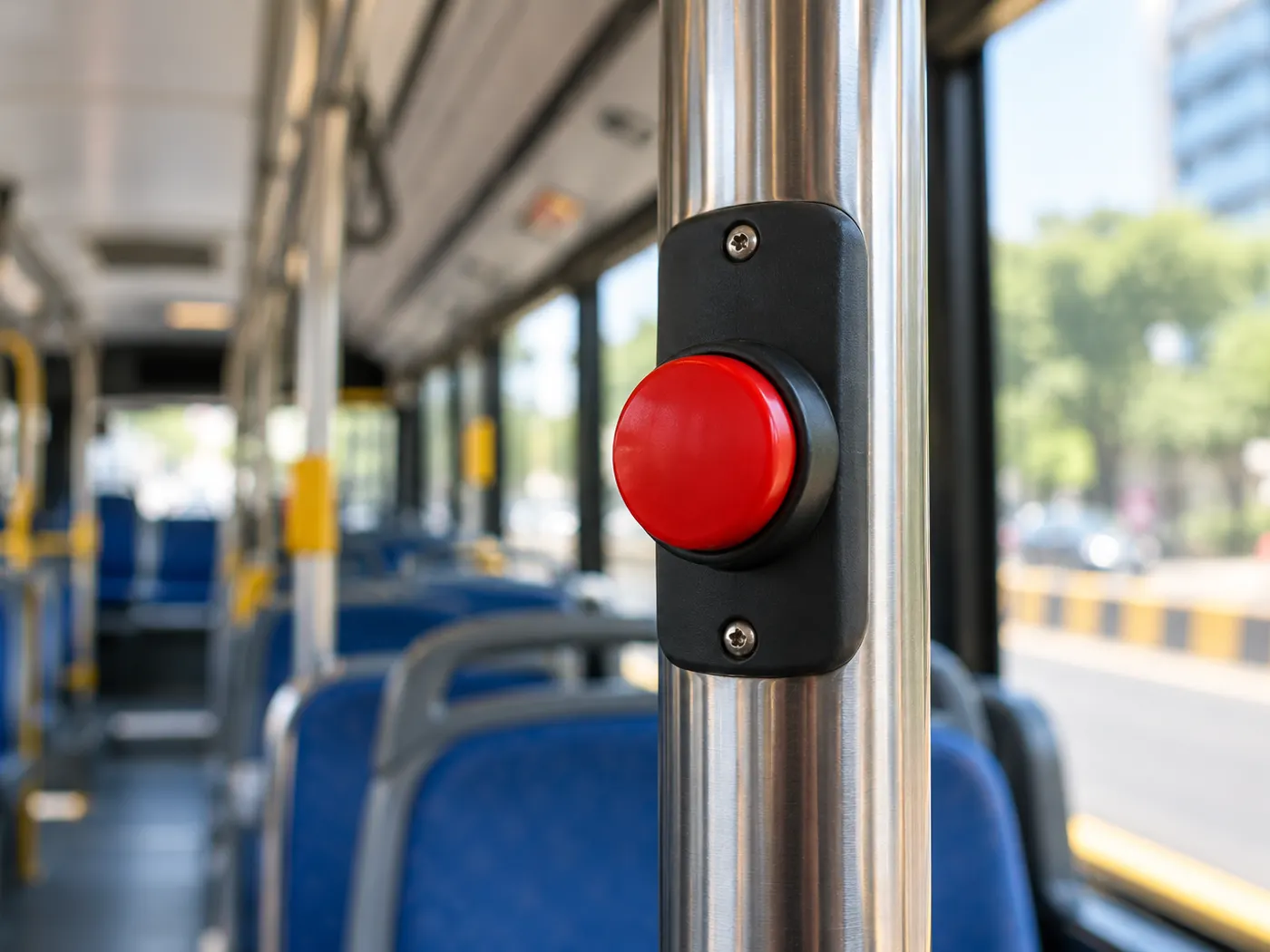
The SOS button in a bus is an emergency alert button for passengers and crew. Pressing it sends a distress alert, along with the bus’s location, to the people or system that is set up to respond.
You may see it called an SOS button, panic button, emergency button or SOS switch. In everyday use these all mean the same thing. Indian rules use the term “emergency button”, and a West Bengal transport notification on the rule describes it as “one or more emergency buttons at conspicuous position”, so look for it on poles, panels or near seats where any passenger can reach it.
- It is an alert, not a control. The button does not brake the bus, cut the engine or open a door. Emergency exits and window hammers are separate.
- It is linked to a tracker. In public service vehicles the buttons are wired to a vehicle location tracking device (VLTD), which knows where the bus is.
- What you notice on board varies. Whether the driver or conductor sees or hears anything when it is pressed depends on the device and on how the state has set up its system.
What happens when you press the SOS button in a bus?
The tracking device sends an emergency alert with the bus’s location to the state’s backend system, where a command and control centre can see it and pass it to the agency that responds. How fast help comes depends on how each state runs that centre.
- A passenger presses the emergency button.
- The VLT device in the bus sends an alert, with the vehicle’s location, over its own mobile connection.
- The alert reaches the state’s emergency response system. The PIB release of 31 October 2018 says states will publish the IP address and SMS gateway of their emergency response system, “where VLT devices will send the emergency alerts on press of emergency button”.
- A command and control centre, run by the state, by device makers or by an agency the state authorises, links the alert to the state emergency response centre, the transport department and RTOs, among others.
- The responding agency acts on the location it receives.
States differ in how far this chain is linked up. In Haryana, a PTI report of 23 June 2025 said the Chief Minister directed officers to integrate the vehicle tracking system with the 112 emergency service. MoRTH supports these state systems under the Nirbhaya framework, and the PIB release says the rule is meant “to ensure safety of passengers especially women”.
Pressing the button does not put you on a call with anyone. If you have a phone and it is safe, also dial 112 and tell them the bus number, route and what is happening.
Which buses in India must have an SOS button?
Public service vehicles, such as buses that carry passengers for hire, must have a tracking device and one or more emergency buttons under Rule 125H of the Central Motor Vehicles Rules, 1989.
Rule 125H was inserted by the Ministry of Road Transport and Highways through notification GSR 1095(E) of 28 November 2016. In October 2018 MoRTH made the device and buttons compulsory for new public service vehicles registered on or after 1 January 2019, except auto-rickshaws and e-rickshaws, and left the date for older vehicles to each state. The devices must meet the AIS-140 standard. Our guide to AIS-140 for school buses in Haryana covers device approval, exclusions and how fitness checks use it, so we do not repeat that here.
SOS, panic button, VLTD, AIS-140 and 112: what each term means
These words get mixed up. Here is the short meaning of each one as used on Indian buses.
| Term | Meaning |
|---|---|
| SOS | International Morse distress signal (· · · — — — · · ·); not an abbreviation, used to mean “help needed now” |
| Panic button | Common name for the emergency alert button; same thing as the SOS button |
| Emergency button | The term used in Rule 125H; a button that sends a distress alert through the tracking device |
| SOS switch | Another everyday name for the same button |
| VLTD | Vehicle Location Tracking Device: the box in the bus that reports location and sends emergency alerts |
| AIS-140 | The Automotive Industry Standard that the tracking device and emergency buttons must meet |
| 112 | India’s single emergency number, run through the Emergency Response Support System (ERSS), for police, fire, ambulance and other help |
When should you press the SOS button, and when not?
Press it when someone’s safety is at risk and you need outside help. Do not press it to test it or to complain about a late bus, because a false alert uses up emergency response time that someone else may need.
- Press it for: harassment or a threat to a passenger, a medical emergency, an accident, fire or smoke, or a bus that is stuck somewhere unsafe.
- Do not press it for: fare disputes, a missed stop, a late bus, or curiosity. Tell the conductor or call the operator instead.
- Children: explain to children that the button is for real emergencies only.
- Pressed by mistake: tell the conductor or driver straight away so they know the alert was not real.
112 works even if a bus has no button. Under ERSS you can dial 112, press a smartphone’s power button three times quickly, or long-press 5 or 9 on a basic phone to send a panic call, according to home ministry officials quoted by PTI at the 2019 launch. There is also the free 112 India app.
Do school buses have an SOS button?
A school bus hired from an operator on a contract-carriage permit is a public service vehicle, so the Rule 125H tracking device and emergency buttons generally apply. For a school-owned bus, check the position with your RTO.
On a school bus the people most likely to need the button are the driver and the attendant, because young children may not press it. That is why many schools also give the driver a phone-based SOS that alerts the school directly. We explain why an SOS button matters for school buses in a separate post, and the wider rules are in our guide to school bus rules and regulations in India.
How DVM Techno Can Help
DVM Techno is a software company with its team in Gurgaon, Haryana. Our SchoolTrack school bus tracking app runs on the driver’s phone and has a one-tap SOS button that alerts the school, parents and emergency contacts with the bus’s live location. The alerts also show on the school’s admin dashboard. SchoolTrack is not an AIS-140 device and does not replace one. Call +91-8448523313 for a demo.
Frequently Asked Questions
What is the SOS full form in a bus?
SOS has no official full form, in a bus or anywhere else. It is the international Morse code distress signal, three dots, three dashes and three dots sent as one sequence. “Save Our Souls” and “Save Our Ship” are popular meanings added later. On a bus, SOS is the label on the emergency button that sends an alert for help with the vehicle’s location.
What is the SOS button in a bus?
The SOS button in a bus is an emergency alert button for passengers and crew. In Indian public service vehicles it is connected to a vehicle location tracking device. When pressed, the device sends a distress alert with the bus’s location to the state’s emergency response system, where a command and control centre can pass it to the agency that responds.
What does SOS in a bus mean?
SOS in a bus means the emergency or panic button. The letters come from the Morse distress signal, which simply means help is needed now. The button does not stop the bus or open a door. It sends an alert with the bus’s location so that help can be sent. Use it only when someone’s safety is at risk.
What is the SOS switch in a bus?
The SOS switch is another everyday name for the emergency button, also called the panic button. Indian rules call it an emergency button and require one or more of them, at a conspicuous position, in public service vehicles along with a tracking device. Pressing it sends an alert. It is not the same as the emergency exit or the door release.
What happens when I press the SOS button in a bus?
The tracking device in the bus sends an emergency alert, with the bus’s location, to the state’s emergency response system over its mobile connection. A command and control centre links that alert to responders such as the state emergency response centre. The exact response depends on the state. If you can, also dial 112 and give the bus number and route.
Is the SOS button compulsory in buses in India?
Yes, for public service vehicles. Rule 125H of the Central Motor Vehicles Rules, inserted by notification GSR 1095(E) of 28 November 2016, requires a vehicle location tracking device and one or more emergency buttons. New public service vehicles registered from 1 January 2019 must have them, except auto-rickshaws and e-rickshaws, and states set dates for older vehicles.
Is pressing the SOS button the same as calling 112?
Not exactly. The bus button sends an alert through the vehicle’s tracking device to the state’s backend, and some states link it to their 112 service. Calling 112 puts you in touch with a person at the Emergency Response Support System, who can send police, fire or ambulance help. In a real emergency, do both if you can.
Related articles
SOS alerts that reach the school, not just a siren
SchoolTrack gives the driver a one-tap SOS that alerts the school, parents and emergency contacts with the bus’s live location, runs on the driver’s phone, and shows every alert on the school’s dashboard.